SafeHer
Active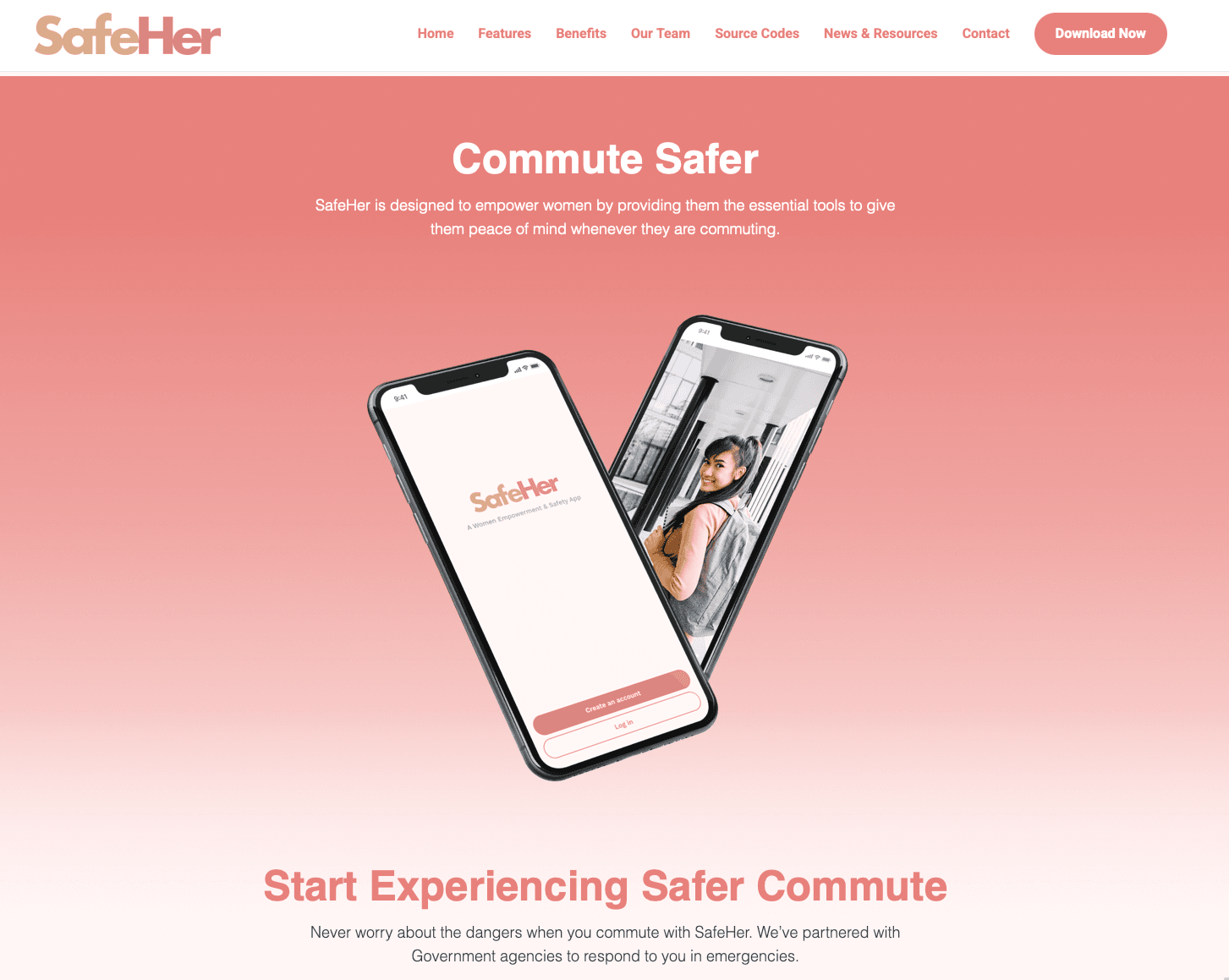
A co-designed app for women’s safety in public transport. Features SOS alerts, live location sharing, scream detection, and a “friends” network. AI enables acoustic event detection and incident analysis to inform policy.
✓ Endorsed
SafeHer addresses an important safety concern for women using public transportation and has the potential to contribute to safer mobility and violence prevention. However, its endorsement should be conditional on further verification of its data protection and privacy safeguards, particularly regarding the collection of personal information, geolocation and user identification. Further assessment is also needed to establish its accessibility and suitability for women in different contexts and circumstances. Therefore, while the initiative is relevant and promising, additional safeguards and evidence of implementation are needed before recommending it without reservations.
✓ Best fit for
Women using public transportation, survivors and indirect to researchers.
✕ Not ideal for
Not yet recorded.
Safety criteria— by category, in rubric order
Privacy & data · 20% of score
38% · 8/8 rated
- Core content accessible without creating an account— No
- No PII collected by default (name, email, IP, location)— No
- Privacy policy in plain language with a short summary— Yes
- User data not sold or shared with third parties— Partially
- Option to use pseudonym or alternative name— No
- No auto-save of form content (shared device risk)— No
- Opt-in (not opt-out) consent — granular and revocable— Partially
- End-to-end encryption used where applicable— Yes
Safety by design · 20% of score
50% · 4/6 rated
- Quick-exit button present (redirects discreetly to neutral page)— No
- Content warnings before sensitive or triggering content— Yes
- Disguised notifications or discreet app icon option— Yes
- No "people you may know" feature that could expose users to abusers— N/A
- Two-factor authentication available— No
- Safe alternative contact options supported (distinct from personal accounts)Not assessed— Not assessed
Agency, consent & participatory design · 15% of score
86% · 7/7 rated
- User controls what information is public vs. private— Yes
- Multiple content formats available (video, text, audio)— Yes
- Self-paced use possible — no forced sequential flows— Yes
- User can opt out of tracking and cookies— No
- Survivors co-designed AND co-iterated — not consulted once only— Yes
- Tool does not force a single pathway (e.g. 'call police' only)— Yes
- Feedback mechanism exists for users to flag issues or suggest content— Yes
Accessibility, equity & inclusion · 15% of score
86% · 7/9 rated
- Available in more than one language— Yes
- Free to use — no paywall for core content— Yes
- Mobile-friendly / responsive design— Yes
- WCAG 2.1 AA accessibility compliance documented— Yes
- Gender-neutral, non-stigmatising language throughout— N/A
- Covers intersectional forms of GBV — not single-issue only— N/A
- Works on low bandwidth / poor connectivity— Partially
- Not geographically restricted in access— Partially
- Mitigates risks for users on shared or monitored devices— Yes
Transparency & accountability · 10% of score
100% · 5/6 rated
- Creator / organisation clearly identified on the tool— Yes
- Last update date visible (signals active maintenance)— Yes
- Scope and limitations clearly stated — including what the tool cannot do— Yes
- Funding sources disclosed— Yes
- Methodology publicly documented— Yes
- Content aligned with global GBV/HP standards and reviewedNot assessed— Not assessed
Tone & trauma-informed UX · 10% of score
100% · 3/5 rated
- No graphic or violent imagery — no sensationalised depictions of violence— N/A
- Uses "survivor" rather than "victim" language throughout— N/A
- Warm, non-judgmental, validating tone throughout the interface— Yes
- Visuals are empowering and gender-diverse — not stereotyping— Yes
- Does not minimise or hierarchise different forms of abuse— Yes
AI & algorithmic ethics · 5% of score
67% · 3/5 rated
- Clearly states if and how AI is used in the tool— Yes
- Clearly states what AI is usedNot assessed— Not assessed
- Provides details of how user's inputs are processed/ saved/ shared with third parties.Not assessed— Not assessed
- Chatbots / automated tools clearly identify themselves as non-human— Yes
- Human escalation pathway available when AI cannot safely respond— No
Sustainability & feminist tech ethos · 5% of score
100% · 2/3 rated
- Led or co-led by women, gender-diverse people, or Global Majority organisations— Yes
- Openly licensed — can be used, remixed or adapted by others— Yes
- Clearly states compliance with feminist values or trauma-informed design or survivor-centred approachNot assessed— Not assessed
See the Transparency page for how the weighted score and bands are calculated.